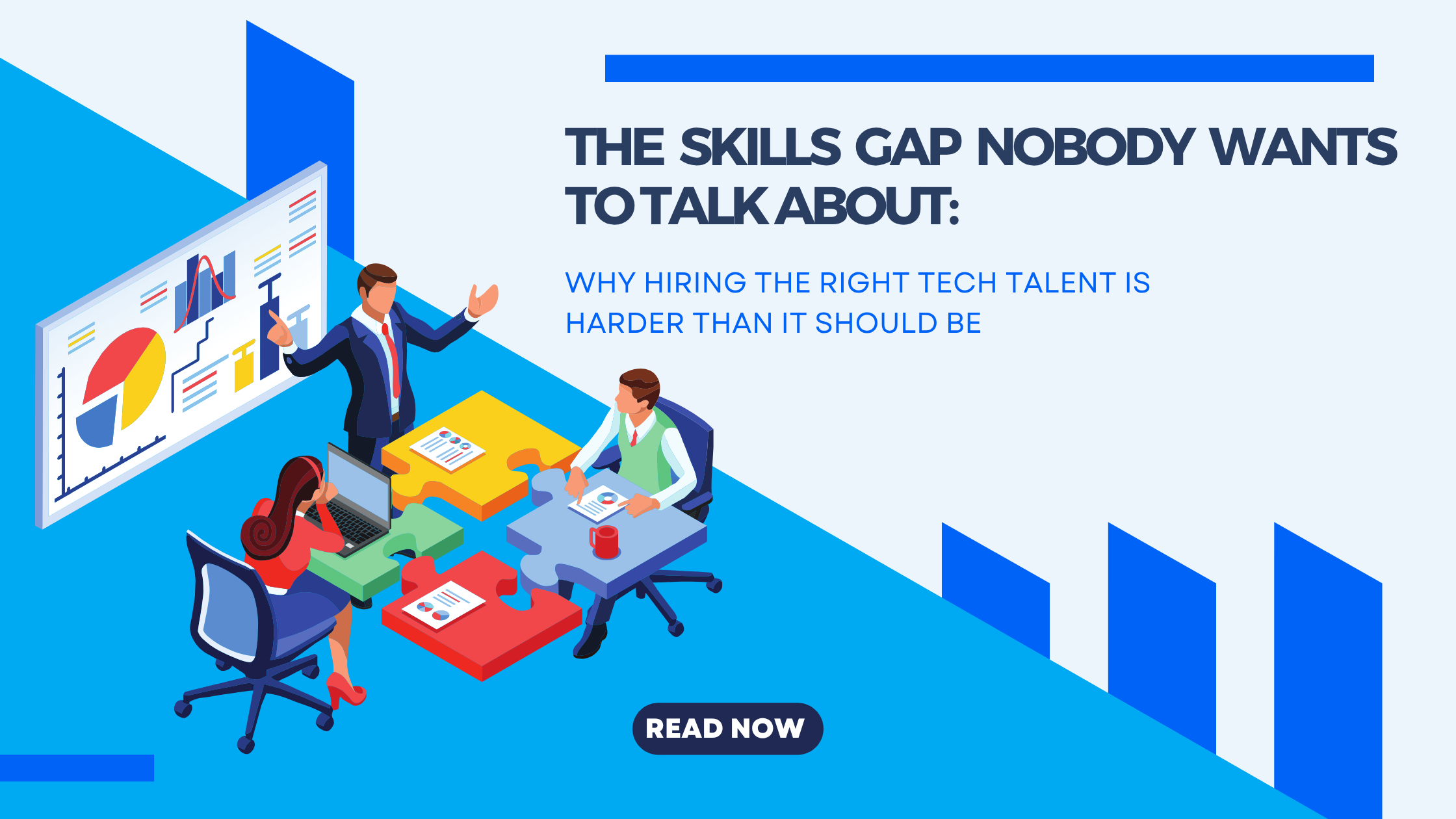
There’s a conversation taking place in boardrooms, leadership meetings, and hiring discussions
across industries.
You see it in critical roles that remain unfilled for months. You hear it when business leaders
say, "We can't find the right talent."
Many organizations are investing heavily in technology and digital transformation, yet relatively
few believe they have the workforce capabilities needed to achieve their strategic objectives.
The skills gap is real but the way we define it has changed.
For years, the conversation focused on talent supply—whether there were enough graduates,
alternative learning pathways, or professionals entering technology careers.
Today, the challenge is more complex.
Organizations often receive a high volume of applications. What they struggle to find are
professionals with the practical experience required to solve today's business challenges. As
technology continues to evolve at an unprecedented pace, workforce demands are changing
faster than many education and training programs can adapt.
The result is not simply a shortage of talent it is a growing gap between acquired knowledge
and real world capability.
Finding software developers is rarely the primary challenge.
Finding professionals who have worked within specific cloud ecosystems, supported production
environments during critical incidents, delivered complex enterprise implementations, or
collaborated effectively across cross-functional teams is significantly more difficult.
That isn't simply a knowledge gap it's an experience gap.
Technical knowledge can be developed through learning. Sound judgment, adaptability, and
effective decision-making are built through hands-on experience, mentorship, and solving real
business problems.
Many organizations invest significantly in learning and development. However, learning alone
does not always translate into capability.
Completing an online course or mandatory training program may satisfy compliance or
development requirements, but it rarely transforms on-the-job performance by itself.
Meaningful upskilling requires opportunities to apply new knowledge, receive continuous
feedback, work alongside experienced colleagues, and solve increasingly complex challenges.
Without these elements, learning risks becoming an isolated activity rather than a driver of
long-term capability.
Organizations making meaningful progress are rethinking how they develop talent.
Rather than relying exclusively on external hiring, they are investing in internal mobility,
continuous learning, and structured career development. They increasingly value adaptability,
problem-solving, collaboration, and learning agility alongside technical expertise.
Most importantly, they recognize that capability is built through experience embedded within
everyday work not solely through formal training.
Technology will continue to evolve. The organizations best positioned for long-term success will
not necessarily be those hiring the most people, but those creating environments where
employees can continuously build the skills needed to meet changing business demands.
At Dasro, we help organizations identify technology professionals who offer more than
technical keywords on a résumé. We focus on connecting businesses with professionals who
bring practical experience, adaptability, and the ability to create value from day one.
If your organization is navigating today's evolving technology skills landscape, we'd welcome
the opportunity to start the conversation.

.png)
.png)