.png)
Every few months someone predicts the ServiceNow skills gap is about to close. New certifications roll out, more developers pick up the platform, and the narrative shifts to "supply is catching up." We don't buy it, and we think candidates who believe it are setting themselves up to undersell their own value.
Here's what we're actually seeing. Companies aren't just looking for someone who can configure workflows and pass a certification exam. They want people who understand the platform at an architectural level: how ITSM, ITOM, and CSM modules interact, how to design for scale, and how to avoid the kind of technical debt that turns a promising implementation into a maintenance nightmare two years later. That's a much narrower pool than "people who know ServiceNow," and it's the pool that actually determines how competitive the market is.
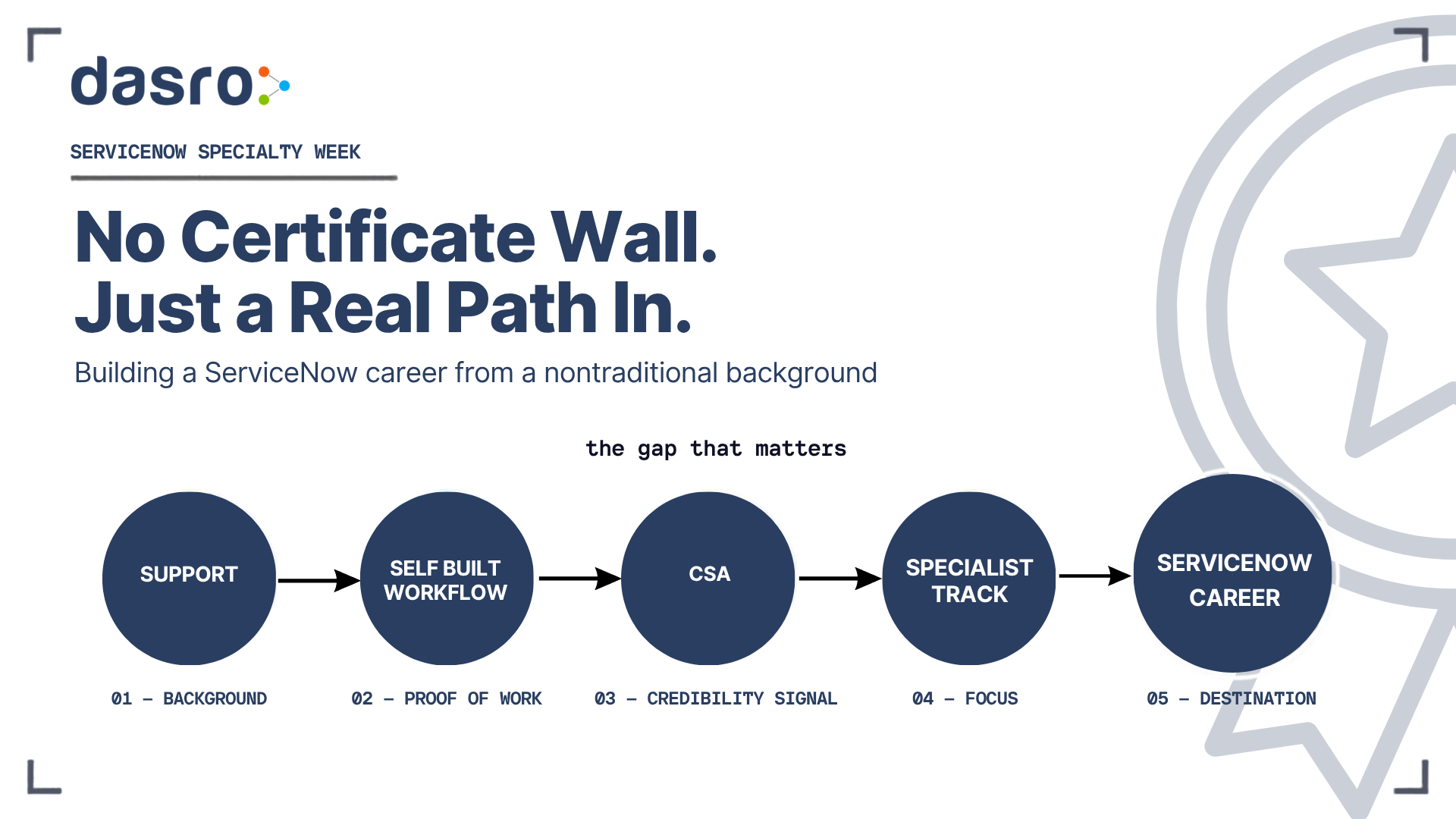
We get a version of this question constantly from candidates: "I have my CSA, why am I not getting more interest?" The honest answer is that certification proves you understand the platform's mechanics. It doesn't prove you can walk into a messy, half built instance and make sound architectural decisions under pressure. Companies hiring at the specialist level already assume certification. What they're screening for is judgment, and judgment doesn't show up on a badge.
This is good news for candidates willing to build a track record, not just a credential. If you've led a migration, rebuilt a broken workflow engine, or made a call that saved a client from a costly redesign, that story is worth more in an interview than another certification acronym. Candidates who lean on certifications alone are competing in a crowded lane. Candidates who can talk through real architectural decisions are competing in a much smaller one, with far less pressure on rate or salary.
Part of why this conversation gets confusing is that "ServiceNow shortage" gets treated as one undifferentiated thing. It isn't. There's no shortage of people who can build a basic catalog item or configure a simple workflow. There is a real shortage of people who can architect multi module implementations, integrate ServiceNow with complex enterprise systems, and troubleshoot performance issues at scale. If you're early in your ServiceNow career, this matters, because it tells you exactly where to point your development. Chasing breadth across every module the platform offers is less valuable than going deep on the specific combination that shows up in the hardest roles: ITOM discovery and event management, CMDB architecture, or complex integration work using scripted REST APIs.
We'd also push back on the idea that this is purely a technical skills conversation. A recurring theme we hear from hiring managers is that they can find technically competent candidates. What's harder to find is someone who can sit in a room with business stakeholders, understand what they actually need (as opposed to what they asked for), and translate that into a workflow design that won't need to be rebuilt in a year. That's a communication skill wrapped around a technical one, and it's chronically underrepresented in the candidate pool.
If you're a ServiceNow specialist evaluating your options, don't let a slower moving job market convince you that leverage has shifted away from you. It hasn't, at least not for people with the right depth. What has shifted is that companies are pickier about verifying that depth before they commit. That means the interview process is likely to go deeper into scenario based questions and architectural reasoning than it used to. Candidates who prepare for that, rather than assuming a resume and a certification will carry the conversation, are the ones landing offers.
It also means it's worth being honest with yourself about where you actually sit. If your experience is mostly configuration and basic administration, that's still valuable, but you're not in the specialist tier this shortage is really about, and pricing yourself as if you are will cost you interviews. If you do have architectural depth, don't undersell it by leading with certifications instead of outcomes.
The ServiceNow market isn't short on people who've touched the platform. It's short on people who can be trusted with the decisions that determine whether an implementation actually works long term. That distinction isn't going away anytime soon, no matter how many new certifications get issued. Candidates who build toward that distinction, rather than assuming volume of experience will speak for itself, are the ones who'll keep finding themselves in demand regardless of where the broader hiring market goes.

.png)