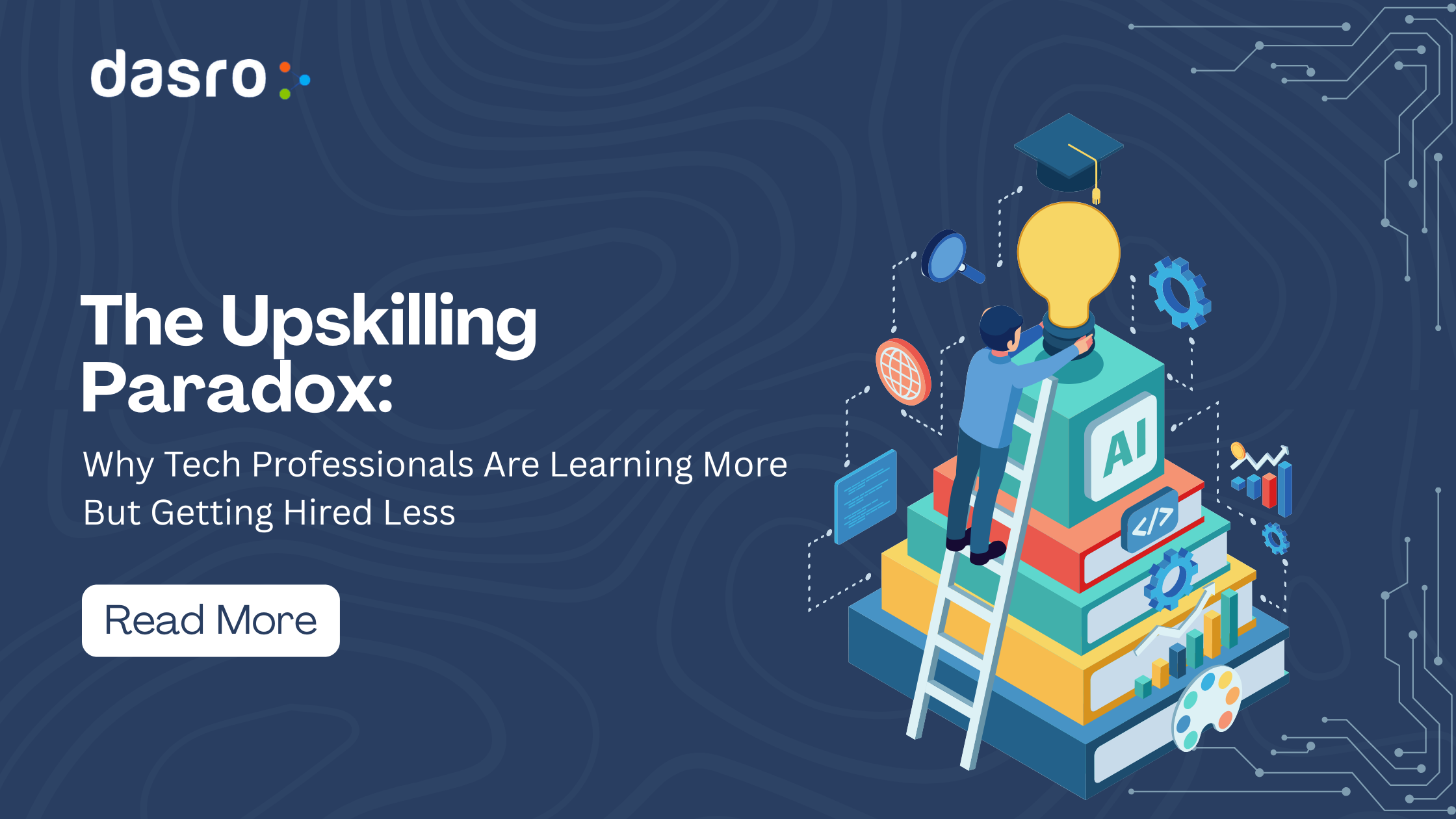
There's a strange phenomenon happening in the tech industry right now. More professionals than ever are investing in courses, certifications, and bootcamps. Online learning platforms are reporting record enrollments. GitHub profiles are filled with side projects. LinkedIn is flooded with posts about completed certifications.
Yet at the same time, hiring managers are struggling to find "qualified" candidates, and skilled professionals are facing rejection after rejection.
Welcome to the upskilling paradox where the more people learn, the harder it seems to break into or advance in tech careers. And if you're caught in this cycle, you're not imagining it. The disconnect is real, and understanding why it exists is the first step to navigating it successfully.
Ten years ago, knowing JavaScript and a basic framework was enough to land a solid developer role. Today, job descriptions for "junior" positions read like wish lists for senior architects: React, Vue, Node.js, TypeScript, Docker, Kubernetes, CI/CD, cloud platforms, testing frameworks, and "familiarity with AI/ML concepts."
This isn't an accident. It's skills inflation—a natural consequence of rapidly evolving technology and an increasingly competitive talent market. As tools become more accessible and learning resources proliferate, baseline expectations rise. What was once considered advanced is now table stakes.
The problem? While the barrier to learning has lowered dramatically, the barrier to employment hasn't dropped proportionally. In fact, in many ways, it's gotten higher.
Here's why: when everyone can take the same online course, complete the same certifications, and build similar portfolio projects, these credentials lose their differentiating power. They become noise rather than signal. Hiring managers receive hundreds of applications from candidates who all list the same skills, completed the same bootcamp, and built variations of the same todo app.
The result is a paradox where being "qualified on paper" no longer translates to being competitive in practice.
The tech education industry has exploded into a multi-billion dollar market. Bootcamps promise to turn complete beginners into job-ready developers in 12 weeks. Online platforms offer thousands of courses on every conceivable technology. Certification programs from major tech companies provide official credentials.
And many of these programs are genuinely excellent. They provide structured learning paths, hands-on projects, and legitimate skill development. The problem isn't the quality of education it's the expectation mismatch it creates.
Candidates complete a certification and reasonably expect it to open doors. After all, they've invested time, money, and effort into verified learning. They've passed assessments. They have a certificate from a recognizable institution.
But from a hiring manager's perspective, that certificate is just one data point among hundreds. It proves you completed a course, but it doesn't prove you can solve novel problems, work effectively in a team, communicate technical concepts clearly, or adapt when requirements change mid-project.
This creates what I call the "certificate trap"—the belief that accumulating credentials is equivalent to becoming hireable. Candidates collect certificates like Pokemon, assuming each one brings them closer to employment. Meanwhile, hiring managers are looking for evidence of applied skills, critical thinking, and real-world problem-solving—things that certificates alone don't demonstrate.
The harsh reality is that the market has become saturated with certified beginners, making it harder, not easier, to stand out through credentials alone.
Job descriptions have become almost useless as accurate representations of what companies actually need. They're written by committee, inflated with every possible skill that might be nice to have, and often copied from other companies' postings without much thought.
When a job listing says "5+ years of experience with React, TypeScript, AWS, Docker, and microservices architecture," what they often mean is: "We need someone who can hit the ground running on our specific tech stack, preferably someone who's dealt with problems similar to ours."
But here's what they're really looking for beneath all those bullet points:
Problem-Solving Under Ambiguity: Can you figure things out when the documentation is incomplete, the requirements are unclear, and Stack Overflow doesn't have the exact answer?
Learning Velocity: Not what you know now, but how quickly you can acquire new knowledge when the project demands it. Technology changes fast—they need people who can keep pace.
Communication Skills: Can you explain technical concepts to non-technical stakeholders? Can you document your work clearly? Can you give and receive constructive feedback?
Ownership Mentality: Do you see projects through, or do you stop at "technically complete" even when it's not truly finished? Do you anticipate problems before they become critical?
Cultural Contribution: Will you make the team better, or just maintain the status quo? Do you bring perspective, energy, and collaboration skills?
The irony is that candidates spend months learning specific frameworks and languages, while employers are desperately seeking these broader competencies—which are much harder to teach and can't be certified.
This disconnect explains why you might have all the technical skills listed in a job description and still not get past the initial screening. You're checking boxes that don't actually matter as much as the posting suggests.
Perhaps the most frustrating aspect of the upskilling paradox is the experience requirement trap. Entry-level positions require 2-3 years of experience. Mid-level roles want 5+ years. Even internships sometimes list experience as "preferred."
For career changers and bootcamp graduates, this creates an impossible bind: you can't get hired without experience, but you can't get experience without being hired.
The conventional advice is to "build projects" and "contribute to open source." And these are valuable activities but they're also what everyone else is doing. Your portfolio of side projects is competing with thousands of similar portfolios.
Meanwhile, companies continue to complain about talent shortages while maintaining experience requirements that exclude perfectly capable candidates who simply haven't had the opportunity to work in a professional setting yet.
This isn't entirely irrational from the employer's perspective. Hiring is risky and expensive. Training takes time. There's pressure to find someone who can contribute immediately. But the aggregate effect is a market where experienced professionals are overwhelmed with opportunities while talented newcomers struggle to get their foot in the door—regardless of how much they've upskilled.
Browse through GitHub or personal portfolio sites, and you'll see the same projects over and over: todo apps, weather apps, e-commerce sites, clone applications of popular platforms. These projects serve a purpose—they demonstrate basic competency with particular technologies but they've become so ubiquitous that they no longer differentiate candidates.
The advice to "build projects to demonstrate your skills" is sound in principle, but it's created a new problem: a sea of similar projects that hiring managers have seen dozens of times before. Your beautifully coded React todo app is competing with hundreds of other beautifully coded React todo apps.
What's more, portfolio projects often don't reflect the actual challenges of professional development: working with legacy code, navigating complex business requirements, collaborating with designers and product managers, making tradeoffs between ideal solutions and practical constraints, maintaining code over time.
A personal project where you control every aspect of the stack, timeline, and requirements is fundamentally different from professional work where you're dealing with technical debt, unclear requirements, and competing priorities.
This doesn't mean portfolio projects are worthless—far from it. But it does mean they're necessary but not sufficient for demonstrating readiness for professional work.
The tech industry sends mixed signals about what it values. Job descriptions list a dozen different technologies, suggesting you need to be a generalist who knows a little bit of everything. But when you dig deeper, companies often want specialists who know their specific stack deeply.
This creates a dilemma for those trying to upskill: do you go deep in one area, risking irrelevance if that technology falls out of favor? Or do you go broad, risking being seen as superficial in your knowledge?
The honest answer is that it depends on the market, the role, the company, and where you are in your career. But that ambiguity makes it hard to invest your learning time wisely.
Early-career professionals often make the mistake of trying to learn everything at once, spreading themselves too thin and never developing deep expertise in anything. More experienced professionals sometimes make the opposite mistake, over-specializing in technologies that may become obsolete.
The sweet spot being T-shaped (deep expertise in one area with broad familiarity across others) is easy to describe but hard to achieve, especially when you're trying to break into the industry and aren't sure which area to specialize in.
So if accumulating skills and certifications isn't enough, what does work? How do you translate learning into employment in this paradoxical landscape?
Build Context, Not Just Projects
Instead of building yet another todo app, build something that solves a real problem you or people you know actually have. The value isn't just in the code—it's in demonstrating that you can identify problems, design solutions, and follow through on implementation.
Better yet, contribute to real projects that people actually use. This might mean contributing to open source, but it could also mean volunteering your skills for non-profits, building tools for small businesses, or collaborating with others on projects that have actual users and stakeholders.
Focus on Demonstrable Impact
When discussing your learning and projects, emphasize outcomes over effort. Not "I learned React and built an e-commerce site," but "I built an e-commerce platform that handles X transactions, with Y performance optimization, solving Z specific challenge."
Quantify where possible. Contextualize why certain technical decisions mattered. Show that you're thinking about real-world constraints and tradeoffs, not just implementing tutorials.
Develop Adjacent Skills
While everyone else is fighting over mastery of the latest JavaScript framework, consider developing skills that complement technical abilities: technical writing, public speaking, project management, UX thinking, data analysis, or domain expertise in areas like healthcare, finance, or education.
These combinations make you unique. A developer who can also write clear documentation is more valuable than one who can't. Someone who understands both code and user research brings perspective that pure technologists lack.
Network Authentically
This advice is given so often it's become cliché, but it remains true: many jobs are filled through connections before they're ever posted publicly. The key is "authentically"—not transactional networking where you're obviously just trying to get something, but genuine relationship building with people in the industry.
Attend meetups, participate in online communities, contribute thoughtfully to discussions, help others when you can. Build a reputation as someone who's knowledgeable, collaborative, and pleasant to work with. Opportunities often come from these connections, not from cold applications.
Embrace Unconventional Paths
Not everyone needs to follow the junior developer → mid-level → senior → principal career path. Consider contract work, freelancing, or consulting as ways to gain experience while building your resume. These paths can be riskier and less stable, but they offer faster learning curves and more diverse experience.
Alternatively, look for roles adjacent to pure development that still use technical skills: technical support, QA, DevOps, technical writing, or solutions engineering. These can be entry points that lead to development roles later while providing valuable perspective on the full product lifecycle.
Play the Long Game
The upskilling paradox is frustrating precisely because there's no quick fix. Breaking into tech or advancing your career requires sustained effort over time, often with setbacks and rejections along the way.
The professionals who succeed aren't necessarily the most talented or the hardest working—they're often the most persistent. They continue learning, building, applying, and networking even when progress seems slow. They understand that career development is measured in years, not weeks.
If you're on the hiring side, you have power to help resolve this paradox. Here are practical steps companies can take:
Write Honest Job Descriptions: Separate "must have" from "nice to have." Be realistic about what's actually required versus what's aspirational. If you'll train someone on your specific tech stack, say so.
Expand Your Candidate Pool: Consider bootcamp graduates, career changers, and candidates with non-traditional backgrounds. Many companies have found that motivated learners with diverse experiences bring valuable perspectives.
Create Entry Points: Internships, apprenticeships, and junior roles with clear growth paths help solve the experience catch-22. Yes, they require investment, but they create loyalty and allow you to develop talent specifically for your needs.
Value Potential Over Current Skills: Especially for earlier-career roles, assess learning ability, problem-solving approaches, and cultural fit over checkbox matching of current technical skills.
Invest in Development: If you're frustrated by the "talent shortage," consider that you might need to grow talent internally rather than expecting the market to deliver fully-formed professionals who exactly match your needs.
The upskilling paradox isn't going away. If anything, it's likely to intensify as technology continues to accelerate and learning resources become even more accessible. AI tools are already changing what skills matter and how quickly they become obsolete.
But understanding the paradox is empowering. It helps you avoid the trap of endlessly accumulating credentials that don't translate to employment. It directs your energy toward activities that actually differentiate you in the market. It sets realistic expectations about the timeline and effort required for career advancement in tech.
The path forward isn't about learning more—it's about learning smarter. It's about understanding what actually matters to employers beyond job descriptions. It's about building real skills, not just collecting certificates. It's about demonstrating value through work, not just claiming competency through credentials.
For those currently stuck in the paradox—sending applications that go nowhere despite genuine skills and learning—know that you're not failing. The system itself is imperfect. But by focusing on substantive skill development, authentic networking, and demonstrating real-world problem-solving abilities, you can navigate through it.
The goal isn't to have the longest resume or the most certifications. It's to become genuinely valuable to an employer—and to be able to demonstrate that value effectively.

.png)
.png)