
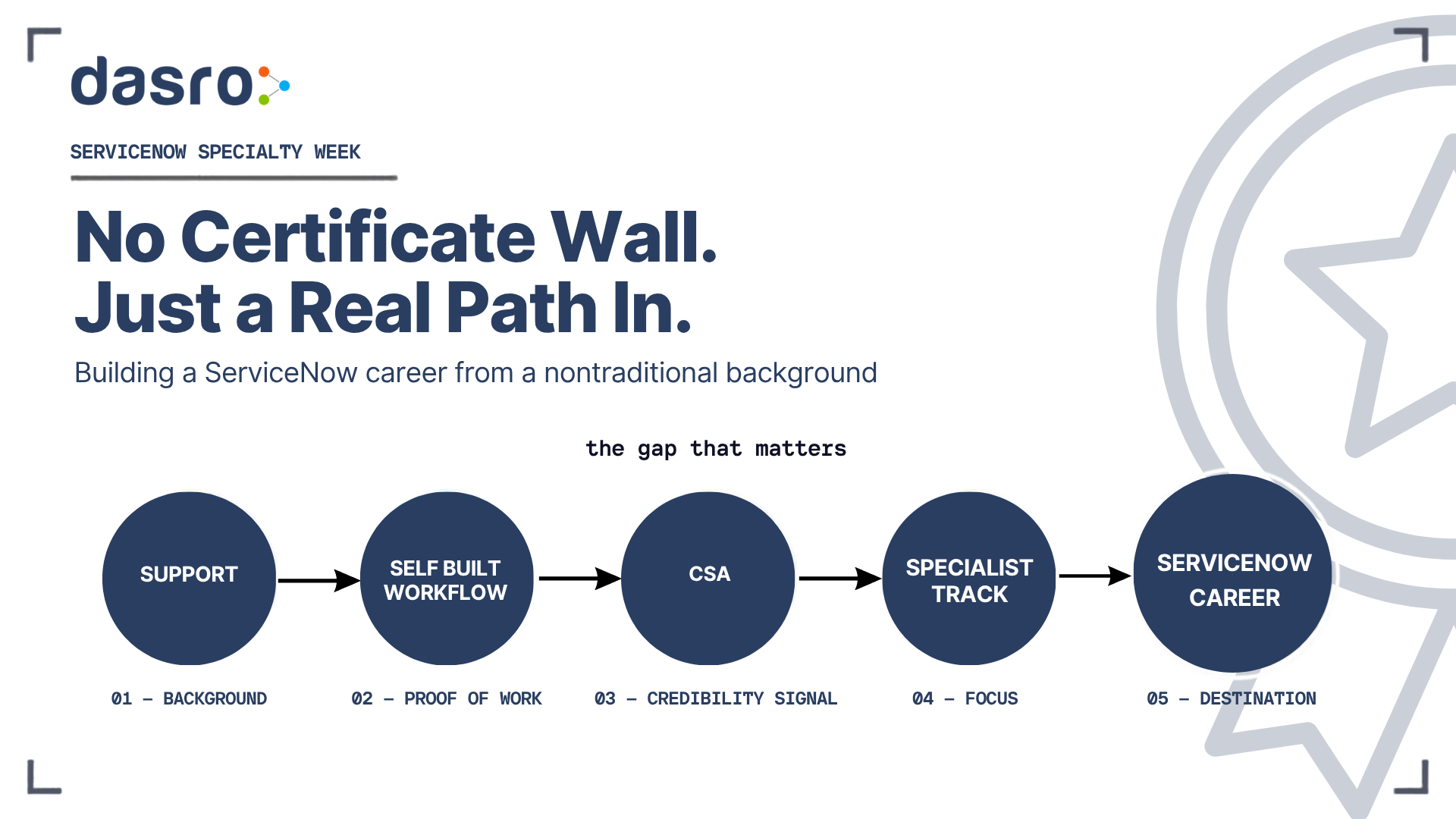
There is a quiet assumption in a lot of ServiceNow hiring: that the strongest candidates came up through a computer science degree, then an admin role, then certifications, in that order. We think that assumption is wrong, and we think it is actively costing companies good hires. If your path into ServiceNow looks nothing like that, here is our honest take on what actually matters and what does not.
We understand why hiring managers default to the traditional path. It is easy to screen for. A degree plus a certification plus prior ServiceNow job titles is a checklist, and checklists are fast. But fast is not the same as accurate.
What ServiceNow work actually rewards is a specific kind of thinking: the ability to look at a messy, manual process and see how it could be modeled as a workflow. That skill shows up in people with computer science degrees, sure. It also shows up in help desk technicians who spent years watching the same broken ticket process repeat itself. It shows up in business analysts who never touched a line of code but understand exactly where a process breaks down and why. It shows up in people who taught themselves the platform on a free developer instance because they got curious.
None of that fits neatly into a checklist. All of it is real experience.
If you are coming from a nontraditional background, the honest question is not "do I belong in this field." It is "which parts of what I already know actually transfer, and which parts do I need to build."
A few things transfer more than people expect.
Process knowledge transfers directly. If you have worked service desk, HR operations, procurement, or any role where you watched a request move from intake to resolution, you already understand the shape of what ServiceNow automates. That is not a small thing. A lot of platform work fails not because someone cannot build a workflow, but because they do not understand the process they are trying to model.
Stakeholder skills transfer directly too. ServiceNow work is rarely just technical. It involves sitting with a department that hates their current process and figuring out what they actually need versus what they are asking for. People coming from operations, support, or customer facing roles often have more of this instinct than people coming straight from a technical track.
What does not transfer automatically is the platform itself. Configuration, scripting, the specific logic of how ServiceNow structures data and workflow. That part has to be learned directly, and there is no way around putting in the hours.
We are not going to tell you certifications do not matter, because they do, particularly early on when you have no work history on the platform to point to. A certification is proof you sat down and learned the fundamentals in a structured way. For a hiring manager who has never worked with you, that is a useful signal.
Where we think people get it wrong is treating certifications as the whole story. A certification proves you can pass an exam. It does not prove you can sit in a room with a frustrated department head and turn a vague complaint into a working solution. Both matter. Neither one substitutes for the other. If you only have one, be honest with yourself and with hiring managers about which one it is, and build toward the gap.
Here is the part of our advice that tends to be less popular: certifications alone will not carry a nontraditional background as far as people hope. What moves the needle is proof of applied thinking.
That can look like documenting a process you improved in a previous role, even informally, and being able to walk through the before and after. It can look like building something small on a personal developer instance and being able to explain the decisions behind it, not just that it works. It can look like contributing to community forums or writing about a problem you solved. Hiring managers remember candidates who can explain their reasoning far more than candidates who list tools.
This is more work than just adding a line to a resume. We think it is worth it, because it is the difference between being one of many candidates with a certification and being the candidate who can actually demonstrate how they think.
This is not just advice for candidates. We push back when hiring managers insist on a traditional background as a hard filter, because in our experience it screens out people who would do the job well and lets through people who look right on paper but cannot actually think through a workflow.
If you are on the hiring side and reading this, our honest suggestion is to weight process thinking and stakeholder experience more heavily than pedigree. The best ServiceNow people we have placed did not all come from the same starting point. What they had in common was the ability to see a broken process clearly and the persistence to learn the platform well enough to fix it.
A nontraditional background is not a disadvantage to apologize for. It is a different starting point, and in this field, starting points matter less than most people assume. If you understand process and you are willing to put in the work to learn the platform, you are already closer to a ServiceNow career than the traditional path would suggest.


.png)


